Sunday, 14 February 2016

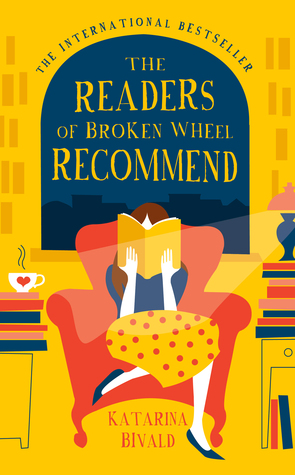
Book Review: The Readers of Broken Wheel Recommend

I noticed this book in an airport book store over the holidays and was immediately attracted by the title.  It is a book about books with a funny beginning; the perfect fit for any book lover.
goodreads.com

Sara Lindqvist is a 28-year-old woman from Sweden who has recently lost her job as a book store clerk.  Prior to this loss, she traded books and letters with Amy Harris, an older woman from Broken Wheel, Iowa.  She decides to visit Amy and take her first trip to the U.S.  Only, when she arrives, Amy has died.

In a charming and not-quite-believable way, the town of Broken Wheel takes care of Sara and insists she stay in Broken Wheel without allowing her to pay for anything.  Sara feels bad for getting everything for free and searches for a way to repay the town for their kindness and generousity.  The town has been hit hard by the economic downturn and has lost its school and most of its inhabitants.  The only solution is to open up a book store.

This was a very enjoyable book with a fairytale-like setting, characters, beginning and ending.  The author's own love of books is evident throughout and made me want to read or reread the books she referenced.  Jane Austen fans will especially enjoy the chapter Mrs Hurst (Books 4: Life 0).  Speaking of which, this book had great chapter titles.  I appreciate chapters with titles.  I've done this a few times in my writing and it takes more thought and effort than simply numbering chapters.  It can also be rewarding for the reader and writer to find the connection between the title and chapter.

This is a translation from Swedish to English and it was sometimes obvious that the translator is not American.  There are British spellings and turns of phrase that were occasionally jarring in a book set in Iowa.  I noticed things like the spelling of tyres, the reference to a "hob" instead of a stove, and frequent mention of being "mad" when an American would say "crazy".  I also wondered that there weren't more comments on the differences in how Sara spoke or acted based on her Swedish background.  I thought this would be more noticeable in a small town like Broken Wheel.

Despite these tiny irritations, I liked the book and would recommend it to other fiction-book lovers looking for a happy ending.
      

Friday, 29 January 2016

Suspiciously Reserved: Chapter One

Here is chapter one of my novel Suspiciously Reserved: A Twist on Jane Austen's Emma.  In this novel, I retell the story of Emma in a modern, Canadian setting from the point of view of Jane Fairfax.  It was a lot of fun to write, but not without its challenges!  How did such a practical,
intelligent and beautiful young woman end up with the precocious, untrustworthy Frank Churchill anyway?

Chapter One
Talk of the Sea
            “Jane, you must come.  I insist!”  Lori said with sparkling blue eyes and perfectly curled shiny, blond hair.
goodreads.com
            “No, really.  I’d just be in the way.  I wouldn’t feel comfortable.”  Jane squirmed in her high-necked sweater.  It was a blustery day in the city.
            “If you only went where you were comfortable, you’d stay in your room from morning till night.  Now, come on.  You’ve never been to White Rock.  You’ll love it.”
            Jane sighed heavily.  She’d just been about to start into her favourite novel – Jane Eyre – when her friend came bustling into her room with this good news.
            “Please tell me, why would I love White Rock?  I who dislike all forms of travel?”
            Lori laughed.  “I love you,” she hugged her friend.  “I know you’ll come.  You always make a big fuss over every change in our lives, but you always come around.  I couldn’t ask for a better friend.  Or sister.”
            Jane and Lori’s friendship was nearly a sisterhood.  Jane had lived with Lori since she was nine years old.  Her early life was a sad tale, one she refrained from telling anyone, but which generally got around despite her best efforts. 
            Jane often felt she had a lot in common with the heroine of her favourite book.  Like Jane Eyre, Jane’s parents died when she was only three.  She was then left to live with her Grandmother and Aunt Bates in Tugaske, Saskatchewan.  Of course, they were nothing like Jane Eyre’s hideous aunt and cousins. 
Auntie Hetty was her mother’s sister.  She had never married.  She was sweet and kind, though she talked altogether too much about trivial things.  Grandma Bates was nearly deaf and generally stuck to her chair.  She was frail and often sick and Jane, already a quiet child, grew up in a home where, though she was loved and admired, she learned to be almost invisible.
            When Jane turned nine, her grandmother and aunt came upon hard times and felt they could not do Jane justice in raising her.  They lived in a small prairie town in Saskatchewan and the public school in her area closed down.  Without consulting young Jane, they decided to accept an offer from Mr. and Mrs. Campbell to have her live in Saskatoon.  She could be closer to a good school, arts and culture, and could live with a little girl her age. 
Bill Campbell had been a very close friend of Jane’s father and insisted on providing for her.  Jane had visited them often since her father’s death.  Her father had once saved Mr. Campbell’s life.  He felt he owed his good friend everything he could give.  Besides, they had always been saddened by the fact they could only produce one child and were pleased to have Jane as their daughter’s companion and almost-sister.
            The Campbell’s kindness to Jane was great and they provided her with better clothing and education than she could have had with her grandmother and aunt, but she always felt herself beneath her friend.  Although the Campbell’s treated the two girls as equals, Jane couldn’t bring herself to accept the credit card they gave her for her sixteenth birthday.  She still felt she was an orphan who should provide for herself, and her aunt and grandmother eventually.
            “Oh Jane, won’t it be wonderful to spend time on our own, away from my parents.  I’m sure Trevor will love me better when he can see me as an independent woman.”
            Jane laughed shortly.  “I don’t think Trevor could love you any better if you were the Queen of England.”
            Lori had been engaged to Trevor for almost two years.  They would be married in October.  Her parents had insisted she finish university before she married.  Like Jane, Lori was twenty-one and had graduated in May. 
She’d met Trevor Dixon on holiday in Seattle.  Jane had been left to stay with her aunt and was surprised that Lori would become engaged when she was only nineteen.  She wondered what kind of man Trevor was, but on his several visits to their home in Canada, she realized he was a sweet-tempered, romantic, caring young man; Lori’s perfect match.
            “Mom and Dad would never let me visit him without you.  Sometimes I think they believe you are more responsible than I.”
            Jane hid a smile behind her book.  A child of six would be more responsible that Lori.  Although she dressed stylishly and was always kind and sweet, she lived up to the expectations of her corn silk blond hair.  Jane was constantly reminding her to act appropriately and keeping her from bad decisions.  She only marveled that Lori had the luck to find such a reasonable fiancĂ© while Jane had been away from her.
            “I’m sure that isn’t true,” Jane soothed.  “So, what am I going to love about White Rock?”
            Jane had never been to White Rock, though the Campbell’s had visited six times since Lori’s engagement.  Trevor’s family owned a holiday home in the ocean city.  Jane insisted on visiting her grandmother and aunt when the Campbell’s travelled.  But the idea of seeing the ocean made Jane rather excited.
            “Oh, Jane!  The scenery!  The sand!  The cute little shops!  You will die, absolutely die at how beautiful it is!”  Lori twirled around the room, knocking over several of Jane’s piles of books.  She had collected them since she was six and, now that she was twenty-one, she had quite a lot of piles.
            “Doesn’t it rain all the time?” Jane countered.
            Lori tisked.  “Not all the time.  We had several days last visit without rain.  It was fantastic!  Perfect.  Oh, we’ll need to go shopping for you.  Immediately!  These turtlenecks of yours are so out of fashion.”
            Lori grabbed Jane’s hand and pulled her from her perch on her tidy bed and continued pulling her all the way to Lori’s bright red convertible.

            Jane’s tastes were as far from Lori’s as a sparrow’s to a blue jay’s.  Lori insisted they shop in an expensive boutique downtown.  She tossed armloads of tight-fitting sweaters and t-shirts into Jane’s open arms, which she soon replaced with sweater sets and cardigans. 
Lori emitted a huge sigh of exasperation when they reached the fitting room together.
“Jane Fairfax!  How do you expect to catch a man in any of these outfits?”  She held up a particularly frumpy grey sweater and threw it to the floor.
Jane retrieved it gently.  “That isn’t my intention for visiting White Rock in any way.”
Lori slumped into an oversized leather chair in the corner of the massive dressing room.   “Well you can’t live with Mummy and Dad forever, can you?  You’re already twenty-one.  What will you do when I’m married?”
Jane often worried about this herself.  Surely Lori’s parents would tire of her once she was no longer necessary for entertaining their daughter.  She had dreamt of living on her own, renting an apartment or travelling abroad, but all this required money, which she had very little of.
“I’ll get work.  Don’t worry about me.”
“But you don’t want to live all alone?  How would you manage?”
More and more, Jane had begun to think she would manage just fine.  Uninterrupted days and nights would be a change, a change she could imagine herself enjoying.  Not to be dependent any longer – what a concept!
“Really Lori, I’ll be fine.  I just want to be warm in White Rock.  I’m going as your friend, not as a woman on the prowl.  I’m more interested in sightseeing, really.”
Lori threw up her hands.  “Fine!  I’ve tried.  But don’t come crying to me when you’re an old maid.”
She left Jane to try on her garments in the fitting room alone.  Jane took a deep breath of precious freedom.
Jane had a bachelor’s degree in education.  After the summer, she planned to begin substitute teaching.  Jane knew she would be too busy with wedding preparations to begin teaching full time.  The clothes she bought now would need to work in the classroom as well as on her travels. 
After a year of substitute teaching, she planned to teach up north – where she imagined she would find peace and serenity.  Jobs were plentiful and the pay was good.  In a few years, she could return to the south and buy a little place of her own.  Plus, she could send money to her aunt and grandma.  This was her focus for now.
Jane tried on a black sweater with some grey pants.  The pants were too big, so she reached for a smaller size.
Besides, Jane had never been in love.  Boys in high school had asked her out a few times, but soon labeled her “frigid” when she continually said no.  That had suited her.  She was embarrassed by Lori’s frequent entanglements. 
Though Lori wasn’t necessarily pretty, she was outgoing, bubbly and had money.  Her boyfriends seemed content enough to have someone agree to date them, until she found someone more interesting.  Lori’s romances had always been exciting and brief.  Yet the boys didn’t seem to mind her breakups.  Jane assumed there was no great love lost on either side.  Now that Lori had Trevor, Jane recognized they loved one another.  She doubted such a thing could happen to her. 
“Jane!” Lori pounded on the change room door.  She sounded very excited.
“I’m almost done.  What is it?”
“You have to see this dress.  It’s so perfect for you.  Come on Janey, open the door.”
Patience had never been one of Lori’s strong points.  She continued knocking on the door until Jane zipped up the pants she was trying on and finally let her in.
“Okay all ready,” she said.
Lori squealed.  “Jane!  Look at his.  Can you believe how absolutely, utterly fantastic this dress is?”
Before Jane really had a chance to look, a blur of red was tossed into her hands and Lori left the room saying,
“I expect to see you wearing that in exactly two minutes, Miss Fairfax.”
Jane held the dress out from her hands and was stunned by the intricate beadwork and beautifully cut lines.  The dress was weighty in her hands, substantial.  She placed it gingerly on a hook on the wall to get a better look.  She gasped when she saw the price tag.
“Lori!  I can’t afford this!” 
“Ja –ane,” Lori said like she was rolling her eyes.  “I have my credit card.  You need a dress for White Rock.  I insist.  If you don’t buy this one, I’ll just keep bringing you more until you agree to one.”
Jane shook her head and unbuttoned her blouse.  She sincerely doubted she would let Lori buy her this dress, but there was no use fighting.  Lori was as stubborn as Jane was private.  But when the dress was on, Jane was amazed at the way it fit her tall thin frame.  The colour brought more life to Jane’s face than she’d ever seen.  Her grey eyes and delicate skin were perfectly emphasized and though Jane had never before owned such a bright colour, she couldn’t deny that she looked beautiful.
“Aha!” Lori trilled when Jane opened her door.  “Just as I suspected.  PERFECT!”  She hugged Jane close and laughed merrily.
Jane had to agree with her friend.  She had never wanted a piece of clothing so badly.
“I don’t need to bring you any more dresses, do I?” Lori asked coyly.
Jane shook her head.

Lori clapped her hands excitedly.  “I knew it!  Didn’t I Jane?  Oh, what would you do without me?”
Wednesday, 27 January 2016

Book Review: This Is Happy by Camilla Gibb

I chose this book because I so enjoyed Sweetness in the Belly. This is Camilla Gibb's memoir describing her
goodreads.com
move to Canada as a young child, her father's mental illness, her family's separation, her own struggles with depression, and the new family she has now stitched together as a result of the birth of her daughter. 


It is a heart-breaking read in many respects, but it is also dotted with hope. This is Happy is also an interesting look into how depression feels and the good, bad and ugly of various treatment options. The book is filled with lovely metaphors, which expertly capture moments in Gibb's life. She comes across as a generous, thoughtful, damaged person doing her best to make the best of life. The entrance of her nanny, Tita, seems to give her new hope and faith in life. Tita jumps from the page as a brave, loving, faithful friend. This book made me question how our cold Canadian culture distances us from one another and could use some pointers from the Filipino and Ethiopian cultures and families described in this book. It brought to mind Julia Cameron's comment in The Right to Write that "So much of the loneliness of modern life comes because we no longer witness each other." 

I was especially struck by Gibb's description of suffering through illness while she lived in Ethiopia. "I was sick for a week and a half as the lithium left my system. I wanted to lie in the dark with a sheet over my head, sleep in silence, daydream, but this was not the Harari way. To be alone is to invite evil spirits, so the women in the neighbourhood kept me company, sitting around my prostrate body, singing songs together, weaving baskets, burning incense, sorting through grains. A tiny girl from the neighbourhood, a girl they called Biscutti, crawled over me, tickled me, hid under the sheet." (p. 40) Such a striking difference from our experience of illness in Canada. 

This is a daring and well-written book. I wish Gibb a bright and family-filled future.

Sunday, 24 January 2016

Book Review: The Professor by Charlotte Bronte

I'm a big Jane Eyre fan, so one of my friends gave me this book.  It is the story of William
From goodreads.com
Crimsworth, who comes from a rich family, but his parents die when he is young and he is raised by some family members.  When he comes of age, he isn't willing to live by the demands of these relations and so he seeks to make his own way in the world.  He starts off by seeking out his brother, Edward.  Edward has inherited the family home and business, but is cold and cruel and is only willing to give William a lowly position in the business.  During this time, William meets Mr. Hunsden who is sometimes friendly, but more often caustic.  Crimsworth doesn't entirely trust Hunsden, but when he quits his job after his brother becomes too cruel, Hunsden recommends Crimsworth to work in a boys school in Brussels.

Crimsworth doesn't really approve of Brussels, or either of his employers.  He is lonely and friendless until he meets Frances Evans Henri, a fellow teacher at the girls school where he spends part of each teaching day.  She is respectful, smart and, most importantly to Crimsworth, Protestant!  (He greatly distrusts Catholics.)  Unfortunately, their burgeoning relationship is thwarted by people, fortune and social restraint, but I will not spoil the ending.

There are certainly similar themes and characters between The Professor and Jane Eyre: The struggle to achieve fortune and respect in a corrupt culture, strong-willed characters, and some of the dialogue between Frances and William is reminiscent of that between Jane and Mr. Rochester.  There is also a strong emphasis on education and teaching.  However, this book is lacking the passion and suspense that I love in Jane Eyre.  Frances isn't quite as fiery as Jane and William is a weak substitute for Mr. Rochester.  Like Jane Eyre, the book is peppered with strange and well-drawn characters, but not enough of them are likeable to be engaging.  It reminded my a lot of Charles Dickens, whom I find difficult.  There is also nothing gothic about this book, which is a shame.

It was an interesting read; however I don't think I'll be inspired to reread The Professor again and again like I am to reread Jane Eyre

Saturday, 23 January 2016

Do I really get to live here?

We had a gorgeous day today.  I talked the kids into going out for a walk and we discovered the beautiful place just below our cottage.  I couldn't help thinking of Walden's Pond.
Walden on amazon

I once tried to read it, but didn't make it through.  I much preferred a thriller called The Shadow Year by Hannah Richell which frequently referenced the classic.

Anyway, here are a few photos.


Is it really January?  Do I actually get to live here?  Oops, we just found out this is private property.  Don't go here if you find it!

Avoiding Volunteer-Fatigue: The Yes-Woman becomes the No-Woman

When we first moved here, I decided to try to say yes to opportunities as much I could.  I was no longer working full time and I had free time to spare.  This is very unlike me.  My natural go-to answer is no, so I think it was a stretching exercise and a great way to meet people in our new community.  However, once January hit, I was faced with the feeling that things are getting a bit too busy.  I was wishing someone would make me one of those lists that help you prioritize where to spend your free time, but instead of looking for one, I thought I'd make one for myself.  I kind of love making lists and I thought it would be more meaningful and valuable to create my own.
I know, I know.  I really need to fit some drawing lessons into my schedule.  I'm supposed to be sticking my tongue out as a sign of deep concentration while I try to figure out how to squeeze something else into the calendar.  Sideways faces are hard.  Also, why are my arms always so long?  

Keep in mind, I don't currently work outside of the home.  When I was a full-time teacher, all I did, volunteer-wise, was to occasionally help with Sunday School at our church and lead a Writer's group.  The Writer's group was really one of my favourite things to do and Sunday School was honestly the bare-minimum way to be involved in my children's education.

For this time in my life, here is my attempt at a priority list of where to spend my volunteer time while still providing enough time to go for walks, meet with friends, read, and write:

1.  Do something you love.  Make sure you have at least one way to volunteer that doesn't feel like work or volunteering.  You should always have something to look forward to.  For me right now, it is volunteering to read with some of the students in my son's class.  Helping kids learn to read and write was my favourite thing about teaching.  I've collected a good set of strategies over the years and I don't want to lose them.  Meeting with kids one-on-one is the best.  You have time to listen to their stories and still get work done.  I always found it frustrating that, even with a small class, there wasn't nearly enough time to listen to all the things kids wanted to tell me.

2.  Be part of a committee.  I have spent a lot of my time doing solitary things.  Writing is largely solitary, playing the piano was solitary, figure skating had some opportunities to work in a group, but was mainly a lone sport, in my experience.  Even teaching has a large element of independent work; although, fortunately, I learned early-on the importance of leaning on colleagues for ideas and support.  Being part of a committee has it's frustrations and even drama, but working through problems and brainstorming new ideas can be very rewarding and good for the brain.  I am the secretary for our school's P.A.C.  Sort of a sweet spot for a writer!

3.  Do something challenging.  (AKA Do something you don't entirely like).  I'm not absolutely convinced of this one and I certainly don't want to advertise that I don't enjoy any of the volunteer work I do.  However, I think there is something to be gained in sacrifice.  Even the volunteer areas you do enjoy likely have some aspect that is annoying or yucky.  Hopefully this will stretch you in a way that you can actually see the good in what you're doing. This does not mean doing something you don't agree with.  There must be merit in what you have volunteered for.  Perhaps you can help to work out the kinks to make the job a better one.  If nothing else, it may inspire some interesting writing!

That's all.  I only wanted three things.  I think I'm now ready to read someone else's list.  How do you prioritize where you spend your time?  Also, do you disagree with any part of my list?  Thanks!


Monday, 18 January 2016

Subgirl: Chapter One with Critical Thinking Questions

Time for another instalment of a chapter from one of my books.  I have previously posted the first chapter of Subgirl, which is written for middle grade readers.  However, this time, it comes with a new drawing as well as some critical thinking questions to be used by teachers, parents or young readers who want more interaction with the book.  I'm working on creating questions and projects for each chapter as a novel study.  Thanks to my colleague Kelli for the idea!  Here's the first chapter:

Chapter One:  Introductions
            There are so many reasons why I, Jordana Simkins, am an odd twelve-year-old, it’s hard to know where to begin.  My appearance would be the first thing you would notice, so perhaps I’ll start there. 
            I’m taller than most girls my age.  In fact, I’m taller than many grown women, including my mother.  While I was at school, this was often an embarrassing fact, especially when I had to dance the polka with short Marty Henderson in gym class.  You’ll notice I used the past tense when I referred to my school days.  I’ll get to that in a minute.  But soon after my twelfth birthday, my height began to be an asset – which is something that is good and helpful.
            I also have impossible fine brown hair which refuses to do anything but lie flat against my skull.  I generally wear it in two long braids down my back, but my mother is forever trying to curl and style my hair in the most outrageous ways.  This too would prove to be an asset in my twelfth year. 
            Another oddity is my thick, thick glasses.  Even after the lenses are shaved down to make them as thin as possible they are over a centimeter in width.  All the other girls my age with glasses are allowed to wear contact lenses and often experiment with various colors; including violet which makes them look rather peculiar, but I have an astigmatism, which means my eyes are shaped more like footballs than soccer balls, which for some reason makes wearing contact lenses impossible.
            Finally, while I have many other abnormal features, I don’t really enjoy talking about them, so I will just briefly mention that I have size 11 feet.  I know, you’re probably rolling on the floor laughing hysterically right now.  It will only make you laugh harder to know that having such large feet often causes me to be clumsy, but is it really fair to laugh at people for things over which they have absolutely no control?  I’m sure you have some part of your anatomy which is a bit strange too. 
            Anyway, it turns out that it is not very common for girls to have size 11 feet.  It’s a better size for a 17-year-old boy or maybe a clown, but the shoe companies interested in twelve-year-old girls do not even consider size 11 as a possibility.  Instead, I have to buy shoes for teenaged boys or shop in specialty shoe stores for woman with large feet.  Apparently, these women don’t care what their shoes look like because all the shoes in these stores are horrible.  Needless to say, I don’t enjoy shoe shopping.
            In all fairness, my peculiarities should stop here.  The rest of me should be normal, normal, normal.  But as my father has taught me since I could talk, which was rather earlier than other children (but I’ll get to that later), life isn’t fair and my differences go beyond my looks.
            Speaking of my father, my parents are both rather unique themselves.  Dad is a rocket scientist and if I could tell you how many times I’ve been told “It doesn’t take a rocket scientist” to figure something out or to do something or to turn on a light bulb, you wouldn’t believe me.  It’s Dad’s favourite joke. 
            “It doesn’t take a rocket scientist to raise a baby girl, Jordana, but it sure helps!” 
For fun, my Dad builds canoes and rocking chairs in our basement with his fellow rocket scientist friend, Mr. Leopold.  My Dad and Mr. Leopold also enjoy puns, which are terrible jokes involving playing with words that are just barely funny, and if I have the misfortune of going downstairs to bring my Dad a phone message or a snack, I am inundated with puns, meaning I have to stand there for a really long time pretending I think my Dad and Mr. Leopold are funny.  Dad will say something like this:
            “Hey Leo, can you give me a hand with this rocking chair?”
            And Mr. Leopold will reply, “But that would leave me with only one!”
            “Ho, Ho, Ho,” they will chuckle while I stand there waiting for them to take the cups of coffee I am trying to give them.
            My mother is equally eccentric.  Although I’m not at liberty to tell you exactly what she does, I can tell you she is heavily involved in the political world and that she often travels and spends many hours at her computer writing letters in foreign languages and encrypting emails to numerous people in similar positions.
            When she isn’t working hard or traveling, my mother loves baking extravagant desserts.  The only problem is that she always gets distracted by a long distance phone call or a triple-encrypted urgent email so that her baking is disgustingly ruined.  But no matter how badly she ruins a dessert, she always freezes her creations in our giant walk-in freezer which takes up the other half of our basement.
So, between my father and mother, we have a house filled with half-baked goodies, canoes and rocking chairs.  I often suggest we try selling some of my parents’ creations, but they just smile at one another, give me a hug and say “We don’t do it for money, darling.  We love what we create, just like we love you and would never sell you no matter what.” 
They’re so weird.  How can I help being a little strange?
            My mother also strives to share her knowledge of foreign languages and so at any given time of the day or night, she will call out a word from among the fourteen languages she reads and writes fluently and ask me to translate:
            “Filaki!” she will say when she comes to my room to say goodnight.
            “Greek for kiss.”  I will reply and she’ll give me an approving kiss goodnight.
            And if you haven’t put down this book yet in fear of my freaky family, I’ll now add the final nail to my coffin, proving how very bizarre I am so that you would never, ever wish to be my friend.  I’m incredibly smart.  Embarrassingly so.  I learned to say the alphabet by my first birthday.  I could add double digits at the age of two and multiply at three.  By the time I started Kindergarten, which was at age four, they made an exception for me, I could read chapter books, do long division and write in paragraph form.
            Kindergarten was a bit of a snap for me, so they bumped me into grade one halfway through the year.  I was still miles ahead of the other children so my parents suggested I tutor children when it was appropriate.  I did – not only grade one students, but grade two and three as well.  When I was five, I completed grades two, three and four and when I was six, I finished elementary school.
            This is when my height became an asset.  At the age of seven, I was already five feet tall and not even the shortest kid in grade seven.  I finished grades seven and eight that year and edited the junior high newspaper. 
By the time I was ten, I had written and aced my grade twelve diploma exams.  The university registrars scratched their heads at my application to attend first year classes.  They decided it would upset the morale of the other students to have a ten-year-old in their classes.  Instead, they agreed to have me take classes by correspondence. 
Within two years, I graduated with a four year degree in education.  I had always helped other students during my school years and so education seemed like a natural step for me.  I even fit in a four-month teaching internship where I learned how to work with a full class of students rather than just a small group.
            During my internship, I learned a lot about classroom management, which is the way teachers get kids to sit down and listen when they would rather be running around the room.  I had a wonderful classroom teacher to work with in a grade one classroom.  Four months was the amount of time I spent in grade one my first time around, so it was good to have a refresher course.
            At the age of twelve, I had a decision to make – study towards a masters and PhD or take up teaching.  I enjoyed my internship so much that I chose to teach.  I’ve always loved helping others learn and I was tired of taking my classes alone in my room.  I was ready to be in a classroom again.
            Again, I puzzled administrators with my request.  A twelve-year-old had never been on the payroll before – in fact it is illegal, where I live, to work for pay until a person is fourteen-years old.  My parents made an arrangement where I would substitute teach towards a scholarship fund.  I would only teach grades one to four so that I would not be too close in age to my students.  All of the administrators but one agreed to this arrangement. 
            Ms. Luella Trites is the vice-superintendent of our school division.  It is fitting that her name, Luella, means “renowned in battle”.  She is a fearsome-looking woman with perfectly manicured nails, hair that never moves, and ramrod straight posture.  She tried everything to keep me from teaching in the school system, but in the end, she was outvoted by the superintendent who thought the schools would benefit from a role model like me. 
My parents have always been with me when I have to see Ms. Trites, but I’m afraid that one day I may run into her on my own.  I’m dreading that day.

            Despite Ms. Trites’ best efforts, I will now enter the life of a substitute teacher before most girls start baby-sitting.  So, that brings me to today – my first day of teaching.

Critical Thinking Questions:
I'd love to know if you or one of your kids used these questions.  You can post your responses in the comment section and I will reply!  You can also let me know if you have better questions or ways to ask these questions.

Why does Jordana think she is odd?
Write about why you think Jordana is or isn’t strange.
Find three interesting words in this chapter.  Draw a picture or use words to explain what they mean.
Draw a picture of what you think Jordana and/ or one of her parents look like.  Make sure you use the descriptions in Chapter One.
What adult job do you think you would be good at right now?  What skills do you have that would make you good at that job?